Your rating:
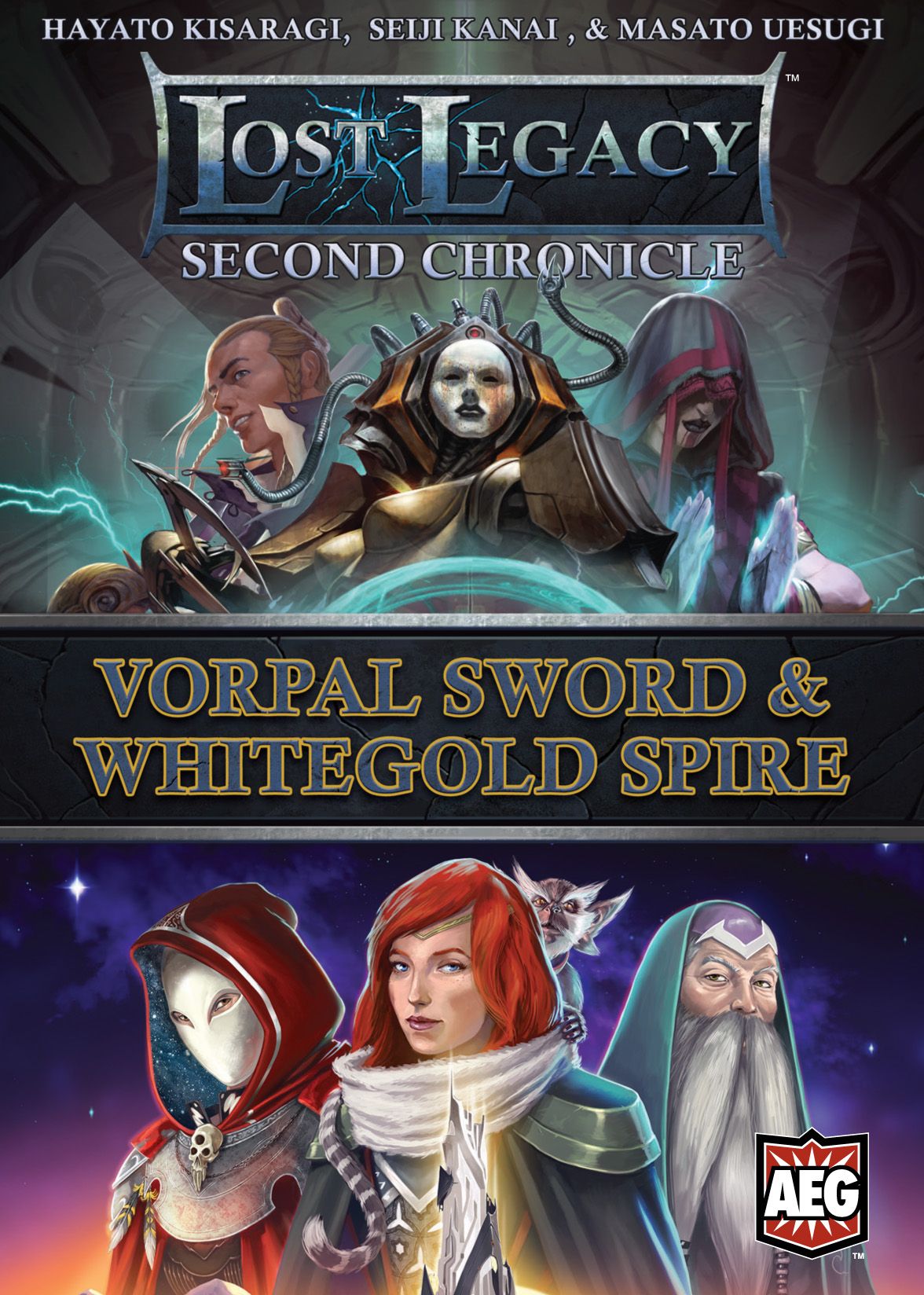
In the distant past, a starship from a faraway world appeared in the sky. Damaged in battle, the craft broke apart and traced lines of fire across the horizon. These falling stars crashed to the surface, and in the ages to come, became enshrined in legends as the Lost Legacy. Discover where the Lost Legacy can be found and win the game! Lost Legacy: Second Chronicle contains two sets of game cards: Vorpal Sword and Whitegold Spire. Each set can be played independently or mixed together with other sets to create a unique custom set. As for how to play, Lost Legacy is a game of risk, deduction, and luck for 2–4 players. You start the game with one card in hand from a deck of sixteen cards. On a turn, you do the following: Draw: Draw the top card from the deck and add it to your hand. Play: Choose one of the two cards in hand to play and place it face up in front of you. Effect: Carry out the played card's effect, after which the card is considered as discarded. End: If there is at least one card left in the deck, the turn goes to the next player; if not, the investigation phase starts. Using the investigation speed indicated on the card each player has in hand, players take turns guessing which player (whether yourself or someone else) holds the "Lost Legacy" card; this card might also be in the "Ruins", a location that holds one card at the start of the game and possibly acquires more cards during play. The player who guesses correctly wins; if no one finds the Lost Legacy, then everybody loses. In Whitegold Spire, when someone discovers the Lost Legacy, the game ends, everyone tallies the value of the cards they've played and the card left in hand, and whoever has the highest total wins. By combining different Lost Legacy sets (while keeping only a single Lost Legacy card in play), up to six players can compete at the same time.
| Year | 2015 |
|---|---|
| Designers | Seiji Kanai, Masato Uesugi, Hayato Kisaragi |
| Artists | Diego Gisbert Llorens, Mario Wibisono |
| Publishers | Devir, Pegasus Spiele, Alderac Entertainment Group |
| Players | 2–6 |
| Time | 10 min |
| Status | Played or rated only |
| BGG Rating | 6.7 |
| Categories | Card Game, Bluffing, Deduction |
| Mechanics | Hand Management, Memory, Player Elimination |
| BGG Rank | 4828 |
| Complexity | 1.27 / 5 |
| Language | Moderate in-game text - needs crib sheet or paste ups |
| Date | Location | Duration | Qty | Players | Scores | Winner | |
|---|---|---|---|---|---|---|---|
|
2015-10-09 | – | 1 | – | – | – |
My BGG Comment
If you know Love Letter (by the same designer), you will quickly understand how to play this slightly more complex version of the game. The principles remain similar: there are a number of card types, some cards exist several times. Players always have a single card in their hand. During their turn they draw a second card and decide which one to keep and which to play. Then the played card effect is executed which may allow you to look at an opponents card, exchange your card with, guess which card an opponent has etc. As in Love Letter the goal is to eliminate the other players through the lose/win conditions built into the cards. In the case of Lost Legacy there are a few more cards plus the Legacy that is hidden in the deck and influences the final results. There are at least 4 decks of Lost Legacy and the cards from these decks can be combined. They are sold in pairs of two decks. If you enjoy the principle of Love Letter and want more of the same with a little more complexity you can't go wrong for the amount this costs (I think 12 euro for two decks). I'd be willing to play this again. We didn't buy it however, as we already own the Munchkin Letter. Also not sure about replayability.