
Your rating:
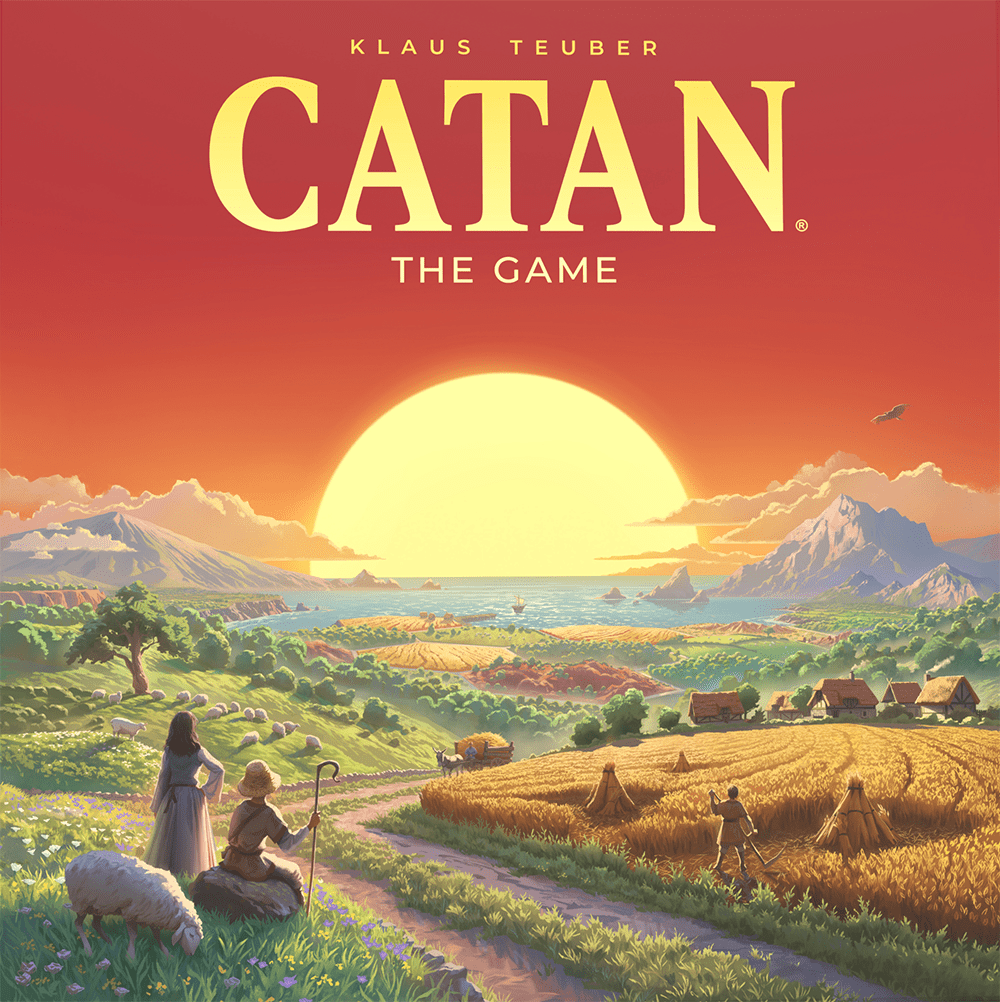
In CATAN (formerly The Settlers of Catan), players try to be the dominant force on the island of Catan by building settlements, cities and roads. On each turn dice are rolled to determine which resources the island produces. Players build structures by 'spending' resources (sheep, wheat, wood, brick and ore) which are represented by the relevant resource cards; each land type, with the exception of the unproductive desert, produces a specific resource: hills produce brick, forests produce wood, mountains produce ore, fields produce wheat, and pastures produce sheep. Set-up includes randomly placing large hexagonal tiles (each depicting one of the five resource-producing terrain types--or the desert) in a honeycomb shape and surrounding them with water tiles, some of which contain ports of exchange. A number disk, the value of which will correspond to the roll of two 6-sided dice, are placed on each terrain tile. Each player is given two settlements (think: houses) and roads (sticks) which are placed on intersections and borders of the terrain tiles. Players collect a hand of resource cards based on which terrain tiles their last-placed settlement is adjacent to. A robber pawn is placed on the desert tile. A turn consists of rolling the dice, collecting resource cards based on this dice roll and the position of settlements (or upgraded cities—think: hotels), turning in resource cards (if possible and desired) for improvements, trading cards at a port, possibly playing a development card, or trading resource cards with other players. If the dice roll is a 7, the active player moves the robber to a new terrain tile and steals a resource card from another player who has a settlement adjacent to that tile. Points are accumulated by building settlements and cities, having the longest road or the largest army (from some of the development cards), and gathering certain development cards that simply award victory points. When a player has gathered 10 points (some of which may be held in secret), s/he announces this and claims the win.
| Year | 1995 |
|---|---|
| Designers | Klaus Teuber |
| Artists | Harald Lieske, Franz Vohwinkel, Stephen Graham Walsh, Pete Fenlon, Michael Menzel, Andreas Resch, Volkan Baga, Tanja Donner, Jason Hawkins, Eric Hibbeler, Michaela Kienle, Andreas Klober, Marion Pott, Quentin Regnes, Matt Schwabel |
| Publishers | 999 Games, Hobby World, Korea Boardgames, Swan Panasia Co., Ltd., Vennerød Forlag AS, Devir, Giochi Uniti, Mayfair Games, Smart Ltd, Eurogames, Descartes Editeur, Galakta, Lautapelit.fi, Kaissa Chess & Games, Albi, Brain Games, Competo / Marektoy, HaKubia, NeoTroy Games, Top Toys, Filosofia Éditions, GP Games, KOSMOS, Ísöld ehf., 64 Ounce Games, Astrel Games, Enigma (Bergsala Enigma), Grow Jogos e Brinquedos, Paper Iyagi, Piatnik Distribution, Stupor Mundi, Broadway Toys LTD, Laser plus, Ideal Board Games, Rozum, MIPL, BGA Plus, Brädspel.se, Spilbræt.dk, Igroljub, Super Impulse, Capcom Co., Ltd., Catan Studio, danspil, Dexy Co, Hanayama, IntelliGames.BG, L&M Games, Logojogos, Ninive Games, Tilsit, TRY SOFT |
| Players | 3–4 |
| Time | 60–120 min |
| Status | Played or rated only |
| BGG Rating | 7.0 |
| Categories | Economic, Negotiation |
| Mechanics | Dice Rolling, Hand Management, Hidden Victory Points, Race, Chaining, Income, Take That, Modular Board, Hexagon Grid, Network and Route Building, Variable Set-up, Market, Trading, Random Production |
| BGG Rank | 625 |
| Complexity | 2.28 / 5 |
| Language | Some necessary text - easily memorized or small crib sheet |
| Date | Location | Duration | Qty | Players | Scores | Winner | |
|---|---|---|---|---|---|---|---|
|
1998-03-24 | – | 1 | – | – | – | |
|
|
1997-03-24 | – | 1 | – | – | – | |
|
|
1997-02-24 | – | 1 | – | – | – | |
|
|
1996-11-24 | – | 1 | – | – | – | |
|
|
1996-11-24 | – | 1 | – | – | – |
My BGG Comment
We played this too much in the 90s. If I never play this again, it is too soon. The same people will always win and to this day my partner has an aversion to "hidden victory points".